
PACE Financing for Impact Windows in Florida
PACE financing (Property Assessed Clean Energy) lets Florida homeowners pay for qualifying improvements, including impact windows and doors, through a non-ad valorem assessment on their property tax bill. It is available only where a county or city has authorized a program. It creates a lien on the property, so compare its total cost with other options first.

What Is PACE Financing?
Florida law lets local governments authorize programs that finance “qualifying improvements” to residential property and collect repayment through the annual property tax bill. Definitions are in Section 163.08, Florida Statutes, and residential program rules are in Section 163.081.
The statute’s list of qualifying improvements includes replacing windows or doors, including garage doors, with energy-efficient, impact-resistant, wind-resistant, or hurricane windows or doors, or installing storm shutters. It also covers certain roof, energy efficiency, and renewable energy improvements.
How Does PACE Financing Repayment Work?
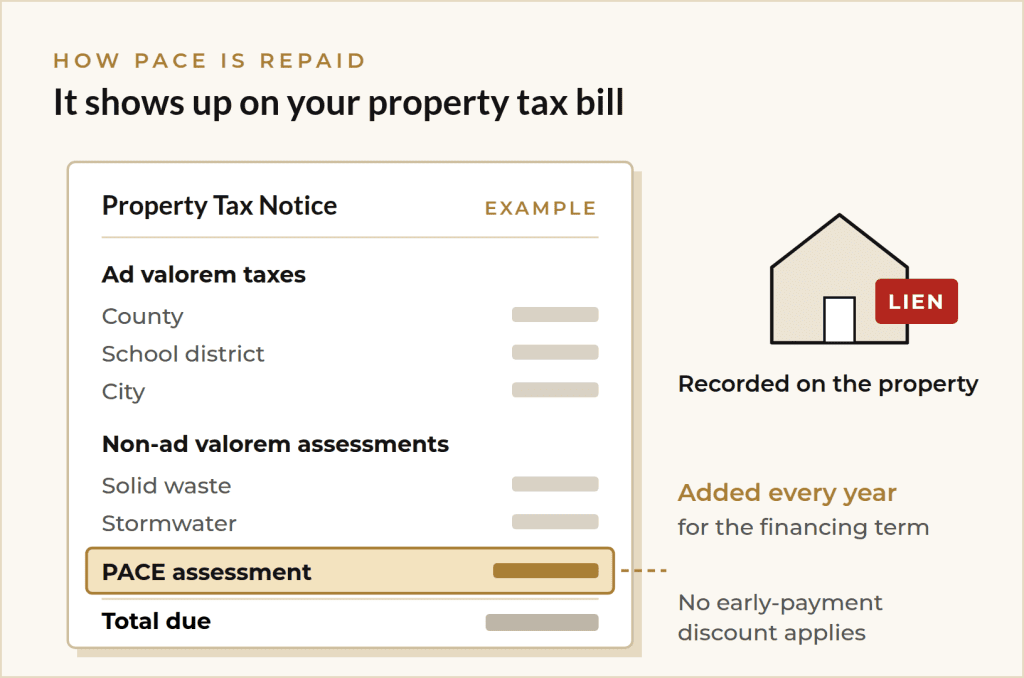
PACE is repaid as a non-ad valorem assessment collected with your property taxes each year for the financing term:
- Your tax bill goes up. The Pasco County Tax Collector notes that if your mortgage payment includes property taxes through escrow, your monthly payment will increase.
- No early-payment discount applies to the PACE assessment, according to Section 163.081.
- Nonpayment is serious. Unpaid amounts can lead to a tax certificate sale and, eventually, a tax deed application, as the Pasco County Tax Collector explains.
Consumer Protections in Florida Law
Section 163.081 sets minimum requirements before a residential agreement can be signed. Among them:
- The total assessment generally cannot exceed 20% of the property's just value unless the mortgage holder consents in writing.
- Estimated annual payments for all PACE agreements on the home cannot exceed 10% of annual household income.
- The term cannot exceed the weighted average useful life of the improvements, and no more than 20 years.
- No negative amortization, balloon payments, or prepayment penalties beyond nominal administrative costs.
- Property taxes and the mortgage must be current, with no recent bankruptcy (limited exceptions) or reverse mortgage.
- A written disclosure must show the financed amount, fees, interest, estimated APR, and payment schedule, each acknowledged by the owner.
- The owner may cancel within 3 business days after signing without penalty.
- For projects of $10,000 or more, the administrator must advise in writing that the best practice is to get estimates from more than one unaffiliated contractor.
Federally, the Consumer Financial Protection Bureau issued a rule applying Truth in Lending Act protections, including ability-to-repay requirements and standardized disclosures, to residential PACE financing, effective March 1, 2026.
Pros and Cons of PACE
Potential advantages:
- Payments are collected with property taxes or through escrow, not as a separate monthly bill.
- Longer terms can mean lower annual payments.
- It can be paid off early without penalties beyond nominal costs.

Cautions to weigh carefully:
It is a lien
The required disclosure says the assessment creates a lien on the property from the date the agreement is recorded.
Selling or refinancing can be harder
State law requires a disclosure that a lender may require full payoff at sale or refinance. The Pasco County Tax Collector warns PACE may impede refinancing and that some major mortgage programs will not insure loans on properties with PACE assessments.
Total cost can be high
Compare APR, fees, and total repayment against other options.
Savings are not guaranteed
Required disclosures state utility or insurance savings are not guaranteed and will not reduce the assessment.
Where Is PACE Available? (Pinellas County Caution)
Residential PACE is available only where a county or city has authorized a program administrator by ordinance or resolution, and availability in our service area has been contested. In a November 2023 consumer alert, Pinellas County stated there was no authorized residential PACE program in the county and warned residents about solicitations; related disputes have been in the courts since.
Status can change, so do not rely on a salesperson’s word. Before signing:
- Call your county tax collector and ask whether a residential PACE program is authorized for your address.
- Ask the provider for the program administrator's name and the ordinance or resolution authorizing it where you live.
- Confirm the contractor is registered with that program, as Section 163.083 requires.
PACE vs. Contractor Financing vs. My Safe Florida Home
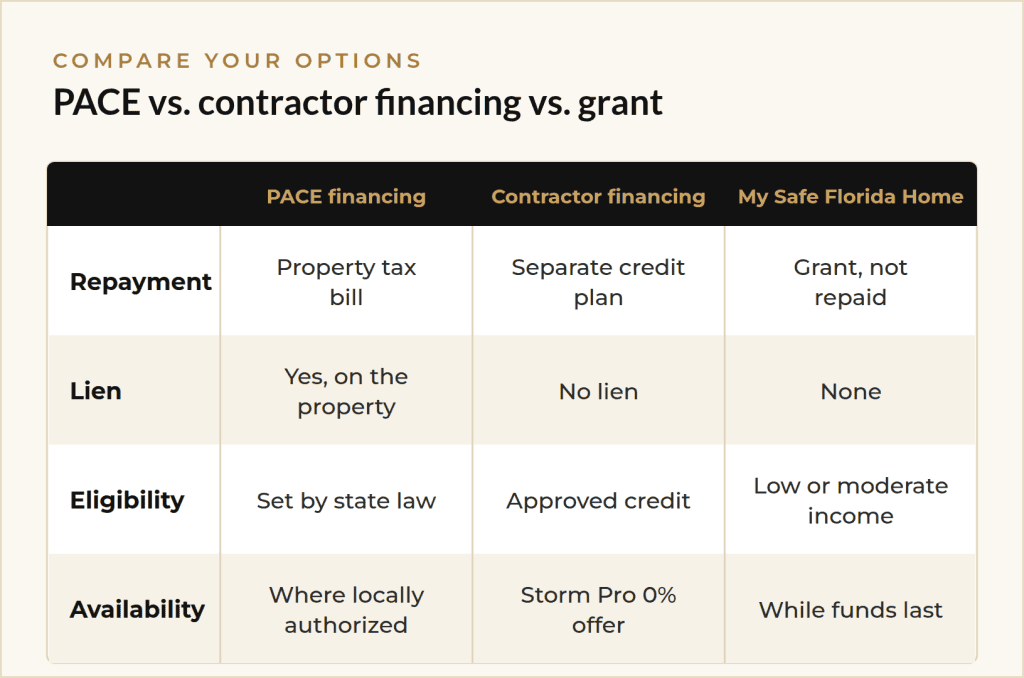
- PACE financing: repaid through your property tax bill, secured by a lien, longer terms, available only where locally authorized.
- Contractor financing: Storm Pro offers 0% financing with approved credit. It is a separate credit agreement, not collected on your tax bill. Review the terms, including what happens if a promotional period ends before payoff.
- My Safe Florida Home: a state grant, not a loan, of up to $10,000 for eligible low and moderate income homeowners who complete the program inspection and receive grant approval before work begins. If you might qualify, check it first.
Some homeowners combine a grant with financing for the balance. Read each program’s timing and proof-of-payment rules before signing. For what drives the amount you would finance, see our impact window cost guide.
Does Storm Pro Offer PACE Financing?
Whatever you use to pay, Storm Pro Window and Door, a Florida-licensed contractor (CRC1334277), provides an itemized quote with product approval numbers for your impact windows and impact doors, pulls the permit, and installs with our own crews, so any lender or program has the documentation it needs.
This page is general information, not legal, tax, or financial advice. Speak with a financial professional before placing any lien on your home.

Official Sources
Every rule, number and deadline on this page comes from the agencies below. Check them directly anytime.
01
02
03
04
05
06
Frequently Asked Questions
Can I use PACE financing for impact windows in Florida?
Florida law lists impact-resistant, wind-resistant, and hurricane windows and doors, including garage doors, as qualifying residential improvements. You can use PACE only if your county or city has authorized a residential program and the contractor is registered with it. Confirm authorization with your county tax collector first.
How is PACE repaid?
Through a non-ad valorem assessment added to your annual property tax bill for the term of the agreement. If your taxes are paid through escrow, your monthly mortgage payment will likely rise. The assessment is not eligible for the early-payment property tax discount.
Does PACE put a lien on my house?
Yes. Florida law requires a disclosure that the assessment results in a lien on the property from the date the financing agreement is recorded. That lien can affect a sale or refinance, and a lender may require the balance to be paid in full.
Can I cancel a PACE agreement?
Florida law requires a disclosure that you may cancel within 3 business days after signing without financial penalty. You may also repay the balance at any time without penalty beyond nominal administrative costs. Read every disclosure before you sign, and keep signed copies with your property records.
Is PACE available in Pinellas County?
In a November 2023 consumer alert, Pinellas County said there was no authorized residential PACE program in the county, and disputes over PACE have continued in the courts. Status can change, so call the Pinellas County Tax Collector or the county before signing any PACE agreement.
Is PACE better than a grant or contractor financing?
It depends on your situation. A My Safe Florida Home grant does not need to be repaid but has income and home requirements. Contractor financing does not place a lien on your property. PACE may offer longer terms. Compare total cost, APR, and the effect on a future sale.